


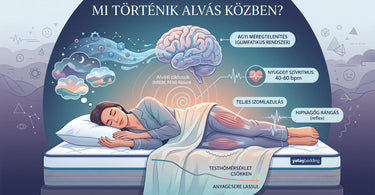
Find out what happens to your body while you sleep! Why do we sweat, drool, and twitch when falling asleep? Answers in Part 7 of the Sleep Guide!
Although it may seem that our body is completely resting during sleep, this is when the most important regenerative processes of the body take place. The brain processes the day's events, cells regenerate, muscles recover, while the hormonal and immune systems are also actively working.
Many people become interested in how sleep works when they experience strange phenomena: they sweat, wake up drooling, or suddenly jerk while falling asleep. But what happens in the body then, and when should you see a doctor?
In this article, we will show you what physiological and neurological processes occur during sleep, what may be behind the most common nocturnal symptoms, and how a suitable mattress can contribute to a calmer, more restful sleep.
What happens to us during sleep? - The basic physiological level
During sleep, the body switches from an awake, energy-consuming state to a regenerative mode. The body then focuses on recovery: breathing slows down, blood pressure drops, pulse decreases, while cells and tissues begin to regenerate.
During the night, non-REM and REM sleep phases alternate. The deep NREM stage is mainly for physical regeneration, while REM sleep plays a key role in memory consolidation, emotion processing, and maintaining brain function.
During deep sleep, the brain's glymphatic system also becomes active, which helps remove waste products that accumulate during wakefulness. If this process is regularly interrupted, cognitive functions may deteriorate in the long term, and the risk of certain neurological diseases may increase.
Many people wonder how many calories they burn during sleep. Although we don't move during this time, the body continuously uses energy to maintain vital functions, thus burning an average of 40-60 calories per hour.
And what is a normal heart rate during sleep? Generally 40-60 beats per minute, which is 10-30% lower than the daytime value. However, if sleep is frequently interrupted, these natural processes can be disrupted, which can have an adverse effect on the immune and cardiovascular systems in the long run.

Why do I sweat during sleep? - Thermoregulation and internal causes
If you regularly wake up with your pajamas or bedding soaked in sweat, it's worth investigating the causes. Night sweats are often a natural phenomenon, but environmental or health factors can also be behind them.
During sleep, body temperature naturally decreases. If the bedroom is too warm, or the mattress and duvet do not provide adequate ventilation, the body tries to release excess heat by sweating.
Yatas Bedding offers anti-sweat mattresses that use innovative solutions to regulate body heat, ensuring your nights are undisturbed.
Increased stress and high cortisol levels can also increase night sweats. If sweating is accompanied by sudden awakenings, shortness of breath, or a feeling of suffocation, sleep apnea may be behind it, so in such cases, it is advisable to consult a specialist.
Why do I drool during sleep? - A sign of muscle relaxation
Many find it uncomfortable, but drooling during sleep is usually a completely natural phenomenon.
During deeper sleep stages, the muscles of the face and jaw relax, while the swallowing reflex also slows down. If someone sleeps on their side or stomach, accumulated saliva can simply flow out of their mouth.
However, if the mouth remains open for a long time due to nasal congestion, allergies, or other airway obstruction, drooling may indicate a problem that needs to be addressed. In such cases, it is worth considering investigating the underlying condition.

Why do we twitch during sleep? - The phenomenon of hypnic jerk
Many people have experienced the feeling of suddenly jerking or feeling like they are falling while falling asleep. This phenomenon is called a hypnic jerk.
As muscles relax and heart rate and blood pressure decrease, the brain sometimes mistakenly perceives this rapid change as if the body is falling. This triggers a quick nerve impulse to the muscles, causing a sudden twitch.
Hypnic jerks are harmless in themselves, but stress, excessive fatigue, late-night caffeine consumption, or irregular sleep can significantly increase their occurrence.
When do nocturnal symptoms pose a danger?
Most nocturnal phenomena are a natural part of sleep, but there are some symptoms that require investigation.
It is worth consulting a specialist if:
- regular loud snoring and breathing pauses occur;
- sudden awakenings are frequent;
- sleep is persistently fragmented;
- daytime fatigue, concentration problems, or memory impairment develop.
Milder sleep problems (sleep disorders) can often be improved with lifestyle changes and at home. A regular bedtime, a cool, dark bedroom, reduced screen time, and an appropriate sleep environment can significantly contribute to more restful nights. However, in cases of persistent or severe complaints, it is definitely recommended to consult a somnologist.
The role of physical support in alleviating nocturnal symptoms
The quality of sleep is significantly influenced not only by lifestyle but also by the bed. An unsuitable mattress can increase tossing and turning, micro-awakenings, and morning fatigue.
A too firm mattress can create pressure points that impair blood circulation and cause frequent changes in body position. A too soft bed does not provide adequate spinal support, which can lead to muscle tension and back pain.
Poorly ventilated mattresses can accumulate body heat and moisture more easily, which can increase night sweats. Well-ventilated, ergonomically designed mattresses, on the other hand, help maintain the ideal sleep temperature, adequately support the spine, and contribute to a calmer, uninterrupted rest.
If you often experience night sweats, you should check out Yatas Bedding's range of anti-sweat mattresses. If stress, increased muscle tension, or restless sleep are causing problems, you can also find a suitable solution among stress-reducing mattresses.
Choosing the right mattress is based on individual considerations for everyone, so we recommend visiting one of our Yatas Bedding stores, where our expert colleagues will provide personalized advice to help you find the most comfortable mattress for you, so that every night can truly be restful.


